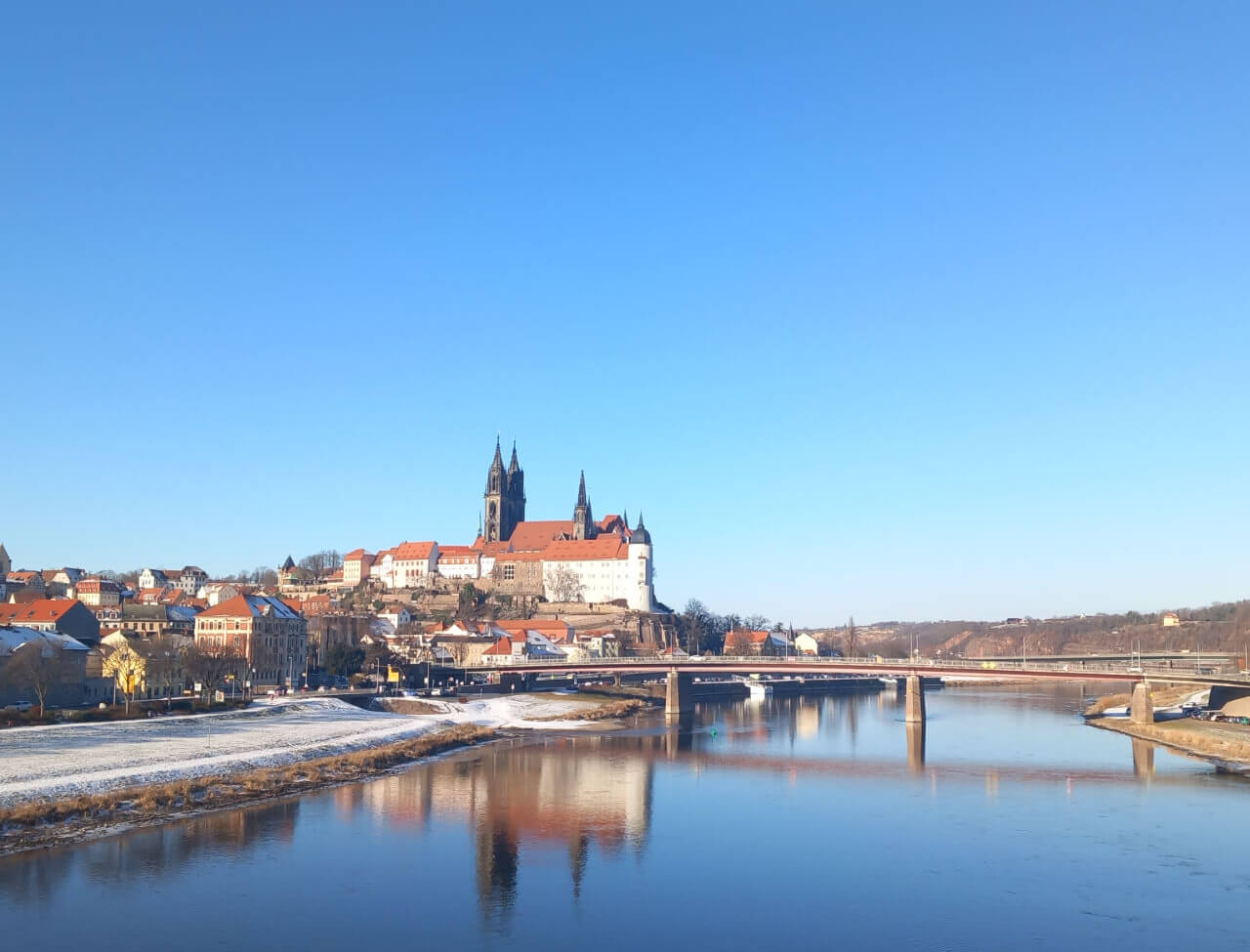
Meissen
"We were welcomed in Meissen"
"We were welcomed in Meissen"
Stage one, stop two

"Meissen, where we were welcomed with equal homeliness. If only we could summon those kind friends down to the southern coast of Sicily! The Elbe rolled in majesty between the Dresden hills. The heights gleamed, as if the buds were just about to burst once more."
Seume passes through Meissen on his stroll. He is greeted by friends but does not tarry; he admires the scenery and follows the Elbe southwards to Dresden.
I, on the other hand, had a few hours to spend. I arrived at midday, a beautiful sunny day with clear skies.
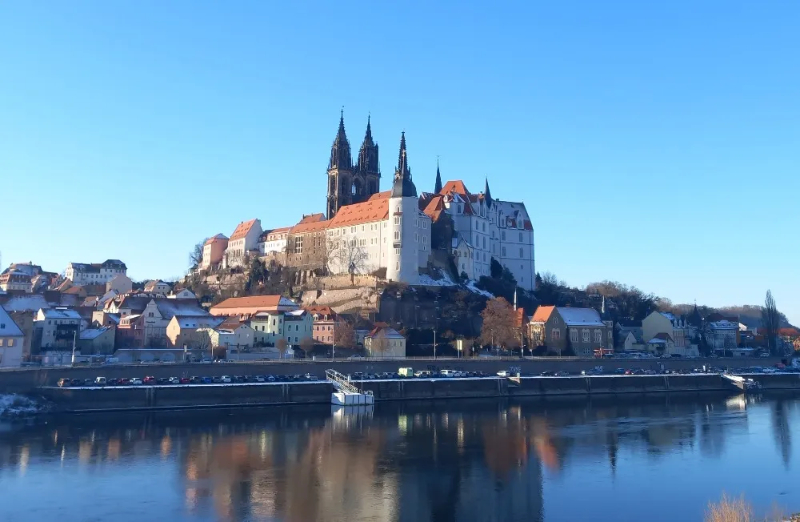
The Albrechtsburg on the river Elbe
Two decades after Seume, Hans Christian Andersen, on a walking tour of Germany and Switzerland, commented in his journal on the beautry of the scene.
"We arrived in Meissen at 10 o'clock. The porcelain factory looked like a church and lay high up on a mountain. The entire trip was delightful: the Elbe with mountains on the one side and mountains with houses on the other"
The city was popular with 19th century tourists to Saxony.
There are few places more favourably situated in the Kingdom of Saxony, than the old city of Meissen. Sunny hills with distant views, vineclad slopes on the bank of the river Elbe, pleasant valleys, and fertile plains are surrounding it in varied turn. Connected with Dresden by railroad and steamboat, the way down from Dresden requires only about one hour’s time.
Meissen is famous for porcelain. The code for producing hard-paste porcelain in Europe was cracked here in 1707 by Johann Friedrich Böttger.
Böttger’s discovery effectively broke the Chinese monopoly on porcelain production and opened lucrative markets for Augustus the Strong, elector of Saxony.
A porcelain factory soon became a must-have for any European prince worth his salt.
The discovery of the code for porcelain is a great story, full of intrigue and excitement. Jane Gleesum covers the discovery in her engaging book The Arcanum.'A porcelain factory,' said Karl Eugen, Duke of Württemberg, 'is an indispensable accompaniment of splendour and magnificence,' and he thought that no prince of his rank should be without one.
'Meissen... is rendered impenetrable to any but those who are immediately employed about the work... they are all confined as prisoners.'
I crossed the Elbe and made my way up through steep medieval streets to Albrechtsburg Castle, where the secret of porcelain was uncovered.
The castle was impressive, largely empty of visitors, and I was free to wander around undisturbed.
Albrechtsburg - photos: Wikimedia Commons (CC BY-SA 3.0)
Later, walking back downhill, I brushed against a thorn bush that tore a large gash in the knee of my trousers.
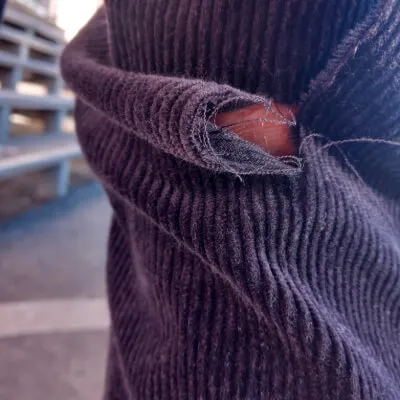
Not having a thread or needle I made my way to the tourist information office who directed me to a local business that could help. Ten minutes later I was in the changing room of a Syrian tailor who quickly stitched them back together again so neatly I could hardly see the seam.
With kneecap now protected against the frosty air, I made my way to the train station and hopped on the train to Dresden.
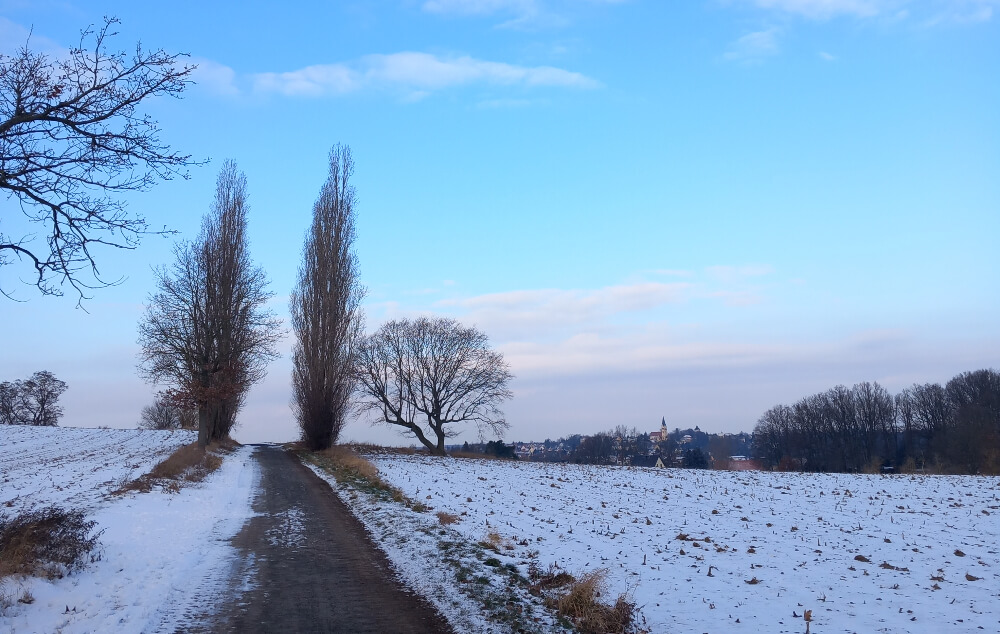
Meissen image.