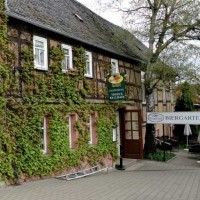
Gaststätte Vogels Ballhaus
Oberwerder 9, 04668 Grimma
View on Google MapsA traditional locals’ restaurant where I enjoyed a schnitzel and a couple of beers. Seume would have liked this place.
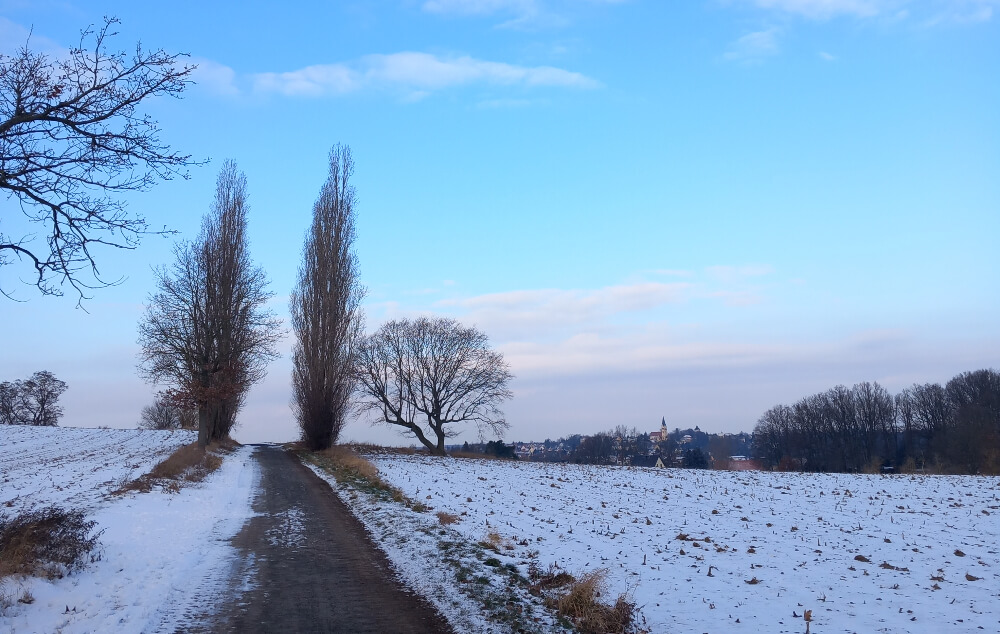
"I buckled on my knapsack in Grimma, and we set off."
Stage one, stop one
The sun shone as warmly as in spring, and we took leave of our companions with gratitude and the brightest hope of return.
Grimma is situated on the banks of the River Mulde, 40 km east of Leipzig, and 84 km west of Dresden. Seume's birthplace of Poserna is 60 km to the west.
Seume moved from Leipzig to Grimma in 1797 to take up a position as proofreader, and later editor, for the publisher and printer Georg Joachim Göschen. He worked and lived in what is now known as the Seume House on Grimma market square. Seume also spent much time at Göschen’s home in the nearby village of Hohnstädt, now a museum dedicated to Göschen and Seume.
It was this period of steady employment that gave Seume the base from which to begin his stroll to Syracuse in December 1801.
The book, A Stroll to Syracuse, opens with the famous line:
I buckled on my knapsack in Grimma, and we set off.
Seume’s companions (at least as far as Dresden) were Veit Hanns Schnorr von Carolsfeld (1764–1841), a Leipzig artist and a certain ‘Großmann’ whose identity remains unclear.
Johann Gottfried Seume set out from Grimma in December 1801. More than two hundred years later, in early January 2026, I flew from London to Berlin, caught a train to Leipzig and another to Grimma. It was late when I arrived. I remember the eerie quiet of the streets, the ornate villas on Leipziger Straße, the medieval Rathaus illuminated in the town square, the pedestrian bridge over the dark, icy river Mulde, the warmth of my Airbnb.
The morning was cold and sunny. I enjoyed a coffee and tasty cake at the very friendly Café Florian, where I also picked up a schnitzel roll for lunch, as I had decided to make the most of the good weather with a hike in the country.
Leaving Grimma, I followed Seume’s route, crossing the bridge over the Mulde and taking a path climbing up the valley and over a ridge in the direction of the village of Döben.
Perhaps it was on this path that Seume recited his traveller’s prayer:
That Heaven might grant me honest, kindly hosts and courteous gatekeepers from Leipzig all the way to Syracuse…
And where he turned around for a final look at Grimma:
I looked back on that fair landscape and thought all the happy days I had enjoyed in the same place: toil and vexation are easily forgotten. There stood Hohenstädt with its fine clusters of houses, and on the slope appeared Göschen’s delightful homestead, where so often we dug, and planted, and weeded, and talked, and harvested, and ate potatoes and peaches. About the hills lay the friendly villages, and the river wound its way in curves through the gorges, where neither path nor oak tree was unknown to me.
Arrival in Grimma. A larger view of the opening landscape.
I reached Döben just before midday, hoping to see the splendid interior of the village's 12th-century Evangelical Lutheran church. Sadly, the church was locked up. I wandered around admiring the exterior for a while, hoping someone would take pity on me and appear with a key, but alas that was not to be.
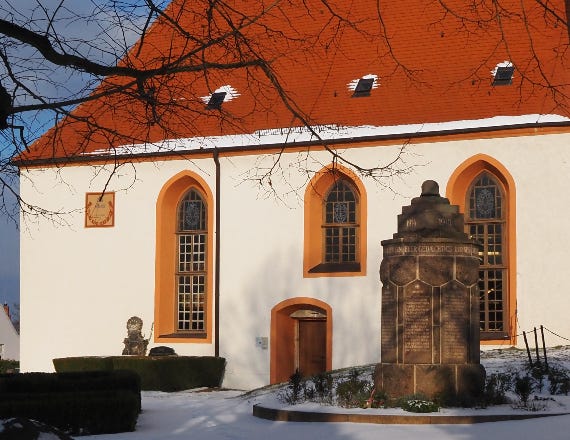
Luckily, I found an article online by Thomas Gatzemeier about the church that includes some excellent photos of the interior. Thomas has kindly permitted me to use some of them here.
It was at Döben that I parted ways for now with Seume; he to trudge eastwards in the direction of Meissen and Dresden while I followed the ridge along the Mulde valley through woods of crunchy snow.
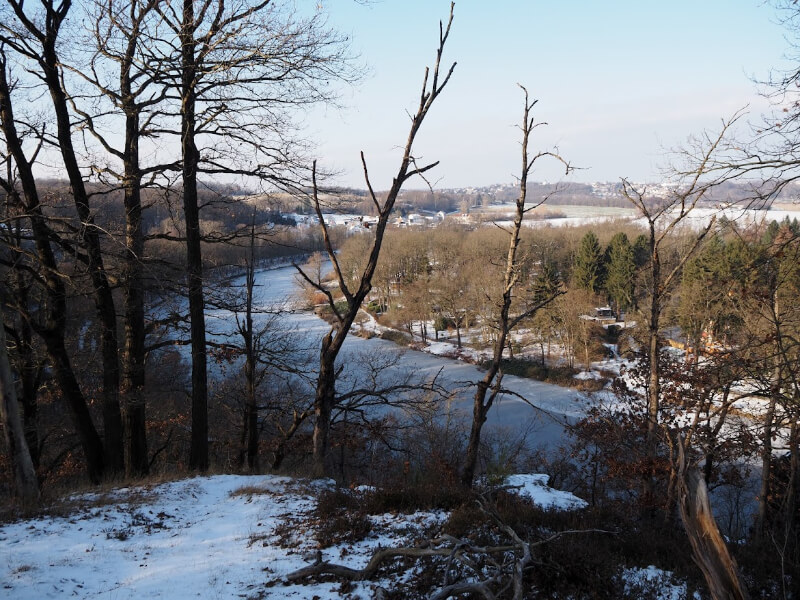
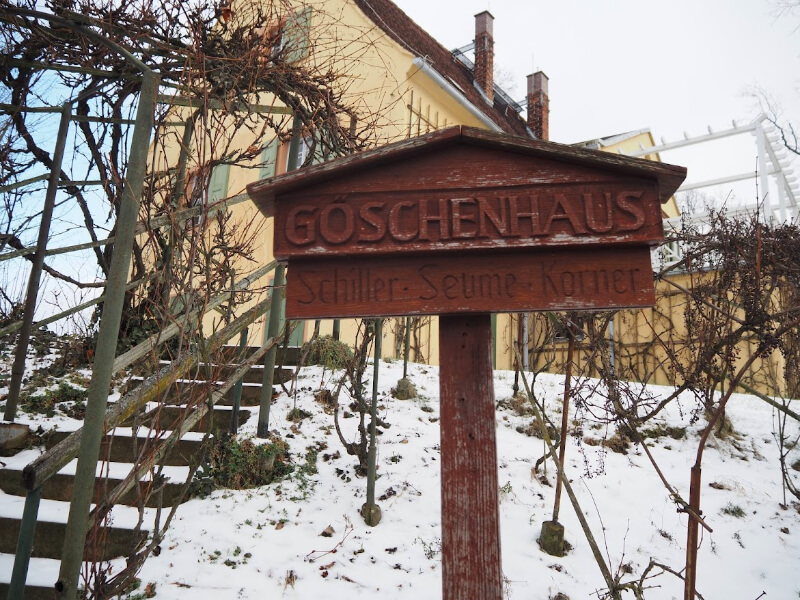
Eventually ascending to the Mulde, I crossed back over on to the west bank and made my way beside the river until reaching the outskirts of Grimma where made a detour to the village of Hohnstädt (now a suburbg of Grimma) to visit the Goschenhaus, a cultural center dedicated to the life and work of Georg Joachim Goschen. The house was a meeting place for writers and thinkers including Friedrich Schiller. It was closed though.
After my nap I went out to explore the town. My first stop was the tourist information office to buy postcards and chat with the staff. A friendly middle age woman told me that Grimma was busy with German tourists in the spring and summer who come for the countryside and boat trips down the Mulde. They got the occasional British tourist on their way to visit nearby Colditz Castle.
The only English 'tourist' I'm aware of is essayist Henry Crabb Robinson, an acquaintance of Seume's, who lived in the town for a while. Crabb was one of the group of friends to see Seume off on his stroll.
Grimma is not at its best in mid-winter, the museum was closed, the impressive looking Frauenkirche Evangelical church was locked up, as were many cafes and restaurants.
I can imagine Grimma is very attractive in the summer, the market square bustling with people selling local produce, seats and chairs out, kids running around, a band playing in the corner.
I did manage to get some photos of The Seume House (now a private residence) where Seume lived and worked.
The Seume House
In the evening I had an enjoyable meal at the Gaststätte Vogels Ballhaus, a very traditional locals’ restaurant where I enjoyed a schnitzel and a couple of beers. To my right was a stammtisch table (a corner table where a group of friends gather at the same time) where four men were enjoying a game of cards. Seume would have liked this place.

In the morning on the way to the train station, I noticed an empty plinth set in a small park. On closer inspection I saw it was a Soviet war memorial, and the plinth had almost certainly once held a tank.
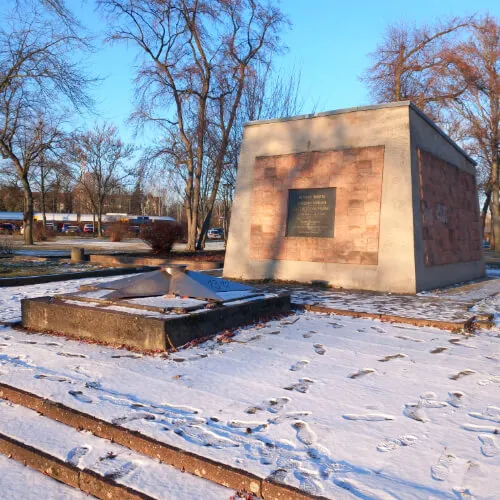
Once at home I was able to confirm my assumption.
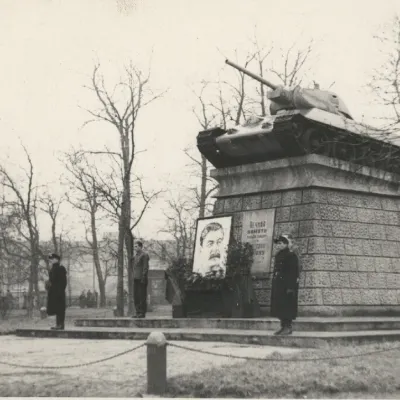
The irony is that the U.S. First Army took Grimma in April 1945, not the Soviets.
I settled into my seat as the train pulled out of Grimma in the direction of Meissen where I would next catch up with Seume.
My grand stroll to Syracuse had begun!
From Hohnstädt Seume set out and trudged along on foot, from town to town, from place to place, all the way to Syracuse. Yet even where the sun beats down, in the deep lands of the South, he did not forget you, my Grimma, nor the shore of the Mulde.
Oberwerder 9, 04668 Grimma
View on Google MapsA traditional locals’ restaurant where I enjoyed a schnitzel and a couple of beers. Seume would have liked this place.
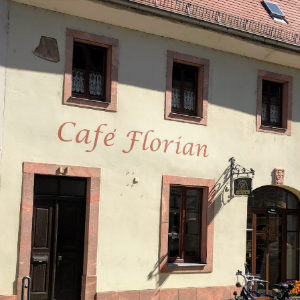
Lange Str. 59, 04668 Grimma
View on Google MapsA friendly stop in the old town for coffee and cake.